Some weekend reading arrives with a bookmark. This one arrived with 17 million lines of code.
A mathematician and Claude tackled the Riemann hypothesis. Yesterday, the people who maintain the proof-checking tools said the proof checks out.
Let’s ride. 🤠
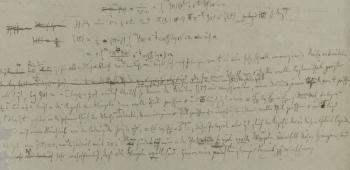
Riemann manuscript, 1859. Göttingen Library, via Clay Mathematics Institute.
A very old question gets a very new answer
On November 21, the Lean and Mathlib communities endorsed Levent Alpöge’s proof of the Riemann hypothesis. Their statement covers both the mathematical claim being proved and the validity of the formal proof.
That is the weekend development worth pausing for. A major AI-assisted discovery has moved beyond its author’s announcement to independent checks of the actual work.
The question dates to 1859 and concerns the distribution of prime numbers: 2, 3, 5, 7, and their increasingly distant cousins. The Clay Mathematics Institute’s explainer describes it as a question about how that distribution deviates from its average.
Its precise formulation involves where certain zeros of the zeta function lie. You can appreciate the achievement without volunteering to explain complex analysis at Thanksgiving; the potatoes have suffered enough.
What the computers checked
Lean is a system for expressing mathematics in a form that software can check. A successful check establishes that the stated conclusion follows from the permitted foundations through the supplied proof.
That leaves an obvious question: did someone prove the right thing? The community compared Alpöge’s theorem with the established Riemann-hypothesis statement in Mathlib, using independent tools, and reported a match.
Separate proof checkers also accepted the exported proof. The checks operated on an inert export, keeping hypothetical malicious code in the source from interfering with the checking process.
MIT mathematician Andrew Sutherland’s verification log gives the unusually concrete details: all 175,187 modules compiled, independent kernels accepted the full export, and a separate sandboxed rebuild reproduced that export byte for byte.
At the page’s November 22 update, some additional checks were still running. That does not erase the completed checks; it does mean that “every check has finished” would overstate the record.
A collaborator, and a lot left to explain
In his four-page announcement, Alpöge describes guiding the work with Claude, then watching it make advances that surprised him. He says the argument is enormous and expects substantial simplification.
He also wants to understand and explain it properly. A machine-checkable proof and a clear explanation for other mathematicians are different achievements, and the second remains an exciting piece of work.
That is an unusually useful picture of AI-assisted research: an expert brings a long-running problem and mathematical judgment; the AI helps push the argument further; other people can inspect a concrete result.
There is no basis here for estimating how quickly a typical user could reproduce the discovery, or for promising that an ordinary chat session will solve their field’s hardest problem.
Something to try on Monday
The practical experiment is smaller: pick a stubborn task where you can independently check the answer, then let an AI explore approaches you have not tried. A failing software test or a calculation with known examples gives you somewhere concrete to start.
Keep the original question alongside the result. Check that the tool solved the problem you actually gave it, and inspect the work before relying on it.
And leave room for delight. Helping someone get further on a question they have cared about since childhood is a pretty good use for a computer.
— Michael
P.S. What problem would you revisit if you had a patient research partner for the weekend?
🎧 From the archive, September 4: The Beyond Brief Daily.