Good morning. London is making more room for people carrying shopping bags; Georgia is making room for Audi.
Plus, a documentary is giving the superhero box office a surprisingly awkward neighbor.
Let’s ride. 🤠
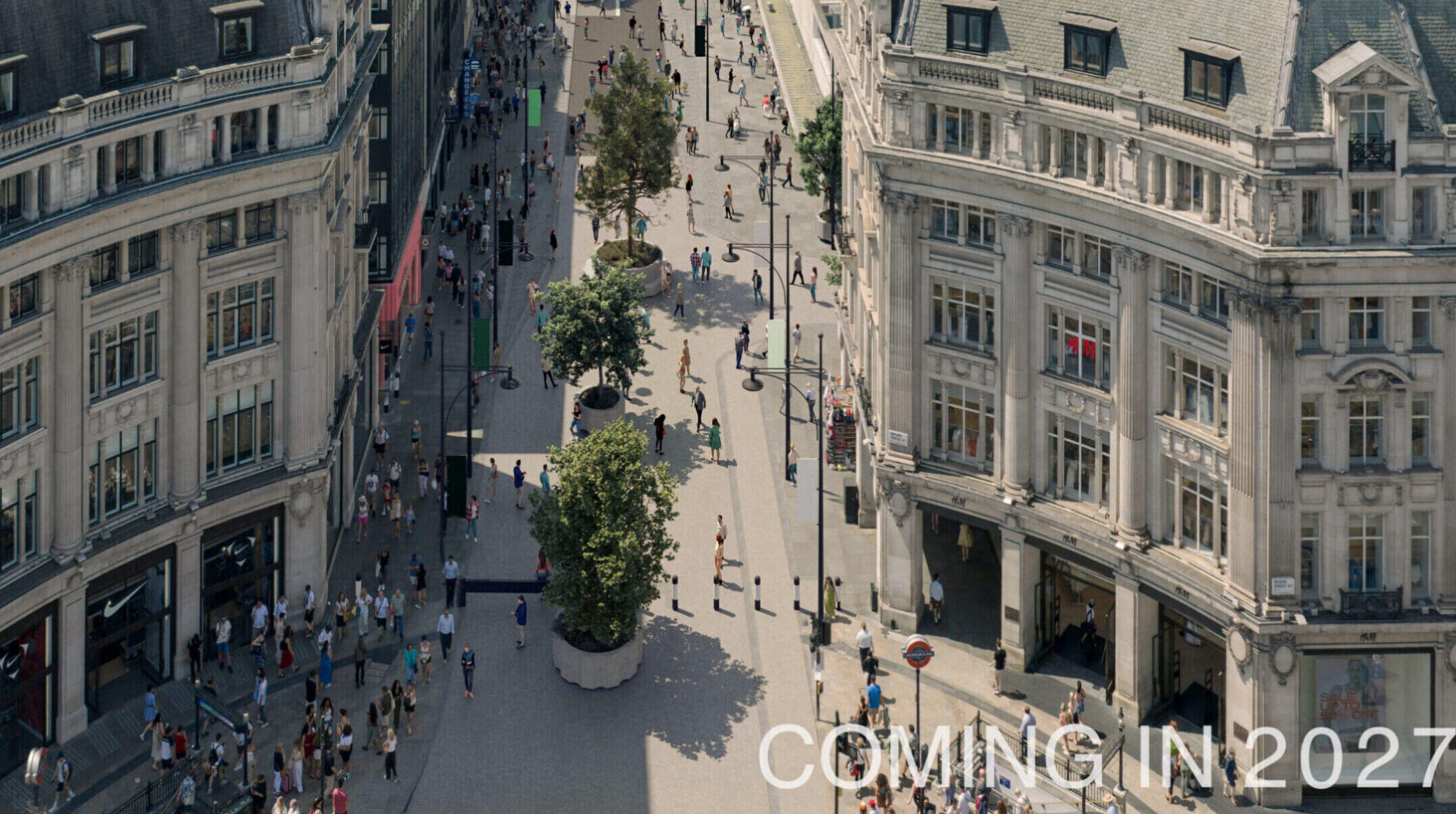
Planned design, not today’s finished street. Visualization: Vincent Atelier / Oxford Street Development Corporation.
🧠 THE BIG PICTURE
Oxford Street gives the road back to shoppers
London’s Oxford Street begins its traffic-free transformation today, with almost a kilometre between Orchard Street and Great Portland Street being pedestrianised. Buses, taxis and bikes get new routes; shoppers get considerably less street to negotiate between shop windows.
The first phase is deliberately modest: clear space before Christmas, then add seating, trees and wayfinding as the project develops. The larger transitional scheme is due by the end of spring 2027, with feedback from residents, businesses and accessibility groups shaping it.
For anyone visiting, TfL’s route changes matter more this morning than the glossy rendering. Your usual bus stop may no longer be your usual bus stop.
The interesting retail bet is simple: make staying pleasant enough that buying becomes optional, then see how many people buy anyway. A bench is a wonderfully low-tech customer acquisition strategy.
🚀 HEADLINES THAT MATTER
Audi picks Georgia for a $4 billion factory 🚗
Audi plans its first U.S. manufacturing facility at the Middle Georgia Megasite in Peach County. The regional announcement puts the investment at about $4 billion and projects 4,500 jobs across a 1,474-acre site.
Grading is planned for 2027, with construction beginning in 2028. That gives suppliers and the local workforce a long runway; a factory announcement starts a regional scramble well before the first car rolls out.

The Georgia announcement. Photo: Choose Macon.
Nathan Fielder is having a very commercial weekend 🎬
The Elizabeth Holmes documentary You Can See Everything earned an estimated $19.5 million over the weekend after expanding its theater count. Nathan Fielder and Lance Oppenheim’s film finished behind Clayface’s $24 million, according to Sunday estimates.
There’s something satisfying about a documentary competing with a comic-book monster for multiplex attention. The takeaway for anyone pitching an odd project: the audience may be broader than the category sounds on a funding slide.
NASA can see autumn’s color chemistry 🍁
NASA’s latest look at fall foliage uses the PACE satellite to distinguish leaf pigments, including red anthocyanins and green chlorophyll. Its instrument measures hundreds of wavelengths, catching differences our ordinary camera pictures flatten together.
The map below uses October 5–11 observations, so it isn’t a live leaf-peeping forecast. Redness can also signal plant stress, including in crops; the useful science is understanding what caused the color, beyond admiring it.

October 5–11 pigment observations. NASA Earth Observatory / Lauren Dauphin, using PACE data; gaps include cloud-covered areas.
Brazil gives Lula a fourth term 🇧🇷
Lula won Brazil’s presidential runoff with roughly 51.8% of the vote against Flávio Bolsonaro, according to AP’s Sunday report. The result gives him a fourth term and interrupts a string of right-wing election victories across Latin America.
For businesses watching the region, continuity in the presidency answers one question. It leaves plenty of others, including how the government will handle trade relationships and turn a narrow electoral win into room to govern.
Big Tech’s spending gets another microphone 💸
Alphabet, Microsoft and Amazon report earnings this week, putting another round of numbers behind the AI expansion story. The useful question is how growing demand translates into revenue while infrastructure spending keeps climbing.
I’ll be listening for concrete descriptions of what customers are buying and where capacity is tight. “Demand is incredible” sounds great, but it doesn’t tell you whether the next opportunity is software, electricity or a very large cooling system.
A useful place to follow AI-assisted mathematics 🧮
A guest post on Terence Tao’s blog introduces a community effort to improve OpenAI’s mathematical write-ups, which can be hard to follow and incompletely cited. Students, researchers and enthusiasts are invited to participate.
The browsable project is the useful link here: a place to explore the work and help clarify it. That seems like a productive way to make AI-assisted research easier for other people to understand and build on.
⚡ RAPID FIRE
⚾ Milwaukee has breathing room. The Brewers recovered from four runs down to win 5–4 Saturday and take a 2–0 World Series lead. Game 3 is tonight.
🇷🇸 Serbia’s political shift. President Aleksandar Vučić conceded his party’s parliamentary election defeat to a student-backed opposition list. This was a parliamentary contest, not a presidential election.
🎵 Elvis enters the AI docket. Rights holders accuse Anthropic of copyright infringement involving 274 songs. Those are allegations, not a court finding against the company.
🤝 AI prices are negotiable. The Information reports OpenAI won most of Replit’s AI spending with a discount exceeding 30%, on a contract above $100 million annually.
🌌 Open a cosmic web. NASA’s Sunday astronomy pick shows dark matter’s simulated structure alongside ordinary matter. It’s a simulation, not a photograph; still a magnificent rabbit hole.
🏗️ Malaysia’s enormous investment pitch. Its prime minister says Masayoshi Son plans $50 billion in technology investment. Treat this as a reported plan, not money already spent.
🔥 THE WEIRD BIT
Microsoft’s Windows Insider anniversary wallpapers reportedly carried metadata showing a Photoshop save on a Mac. That identifies a save operation, not every step of their creation.
Still, celebrating Windows with a little help from macOS is excellent workplace comedy. Platform loyalty apparently ends somewhere around File → Save.
That’s the briefing. Now go build something.
— Michael
P.S. Which street in your city would be better with more benches and fewer cars? Hit reply; I’m collecting nominations.
🎧 Podcast archive: Nvidia Buys the AI Community for $13B — September 4.