🎉 A playground slide just earned a place in a museum. Finally, recognition for a product whose entire pitch is “gravity, but fun.”
Also today: Dropbox makes a $350 million move, and Wendy’s would prefer you order the company at a higher price.
Let’s ride. 🤠
🧠 THE BIG PICTURE
The slide joins some very famous cardboard
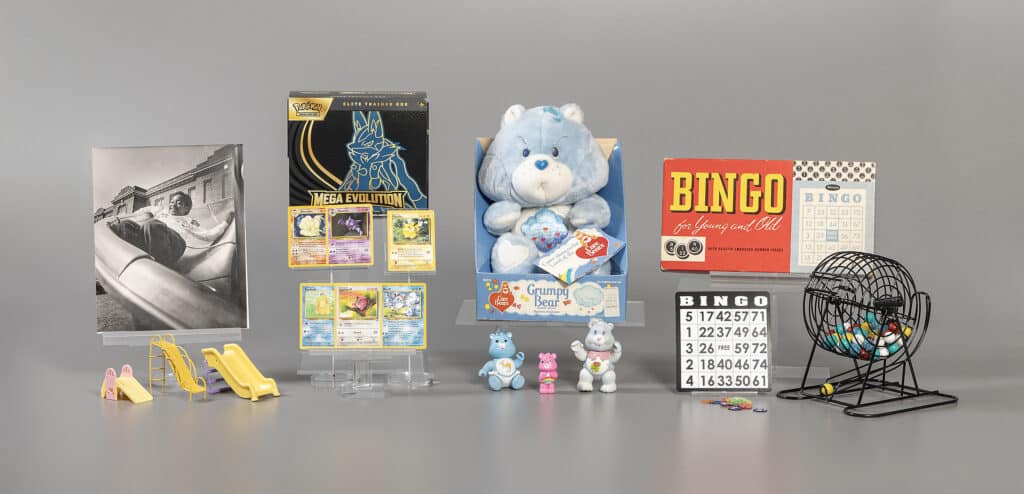
The National Toy Hall of Fame’s new class includes Pokémon’s trading card game, Care Bears, bingo, and the playground slide. The Strong museum announced the four inductees Thursday, choosing from 12 finalists that included Tickle Me Elmo and Yahtzee.
Pokémon’s card game debuted in 1996 and has produced billions of cards. Its appeal combines approachable rules with creatures people already know from games and animation: an unusually effective way to make collecting feel like participation.
Care Bears brings a different kind of staying power. The museum cites more than $12 billion in reported lifetime retail sales for the brand, whose characters have been teaching feelings since the early 1980s.
Then there’s the slide, quietly succeeding without a cinematic universe. The hall rewards enduring popularity and creative play, which makes this a wonderfully democratic lineup: licensed characters, competitive collecting, numbered balls, and a slope you can sit on.
🚀 HEADLINES THAT MATTER
Dropbox wants to store the work AI does
Dropbox agreed to acquire Tigris for about $350 million, with closing expected this quarter. Its new DBX Agent Cloud starts with storage compatible with Amazon S3, letting developers use familiar tools.
Separately, AI inside Dropbox can summarize folders, edit documents, and organize files; more than 70,000 teams have received the rollout. The appealing bit is working with files where they already live, rather than repeatedly carrying them between apps like digital moving boxes.
Google gives your video another five seconds
Gemini Omni 1.2 Flash extends generated clips from 10 to 15 seconds and lowers 720p pricing to seven cents per second, a 30% cut. Google says follow-up prompts can revise the same clip instead of starting over.
That makes trying a different background or product shot more practical for small creative teams. Google also flags continuing work on fast sports action and complex physics; perhaps let actual gravity handle the skateboard commercial for now.

Wendy’s declines the takeout order
Wendy’s independent directors rejected a group’s $7.35-per-share cash offer, saying it substantially undervalues the business. The bidders include Trian Partners, Flynn Group, BlueFive Capital, and Sixth Street.
The board also adopted a limited-duration shareholder rights plan to resist an unwanted takeover. Investors now have two competing propositions: cash from the buyers, or the upside management expects from its turnaround.
“Would you like to make that a larger offer?” has entered the drive-thru vocabulary.
The Times reportedly wants your movie diary
The New York Times Company is in exclusive talks to buy Letterboxd for roughly $330 million, Reuters reports, citing the Times. No agreement has been reached, and the discussions could fall apart.
The movie community would fit a company already collecting reasons to visit beyond the news, from Wordle to The Athletic. A film diary also gives people a reason to return after the credits roll; your two-star review might be someone else’s subscription strategy.
A telescope’s very long encore ends
NASA’s Swift observatory reentered the atmosphere Wednesday after nearly 22 years studying powerful cosmic explosions. An attempted mission to lift it into a higher orbit had failed.
NASA’s farewell today features a 2018 mosaic assembled from the first million images taken by its ultraviolet/optical telescope. The spacecraft is gone, but its observations remain available for scientists to investigate.
That’s a remarkable second life: years of discoveries can still come from a telescope that has stopped taking pictures.

Wall Street has a very bad Thursday
The Nasdaq fell 5.5% Thursday, while the S&P 500 lost 4.4%. Nvidia dropped 9.3% as worries about potential restrictions on data-center construction hit the AI trade.
Those are closing prices, not a forecast for Friday. Expectations for future construction are baked into today’s valuations.
Useful AI products can keep improving while investors decide they were paying too much for the companies around them. Both things can happen on the same afternoon.
⚡ RAPID FIRE
Less waiting: Microsoft says its updated Xbox PC app launches up to 60% faster in testing. Xbox Insiders get the first look; results vary by setup.
Save the tables: The IRS’s 2027 inflation adjustments raise the married-filing-jointly standard deduction to $33,200. These generally concern returns filed in 2028, not the next filing season.
Grid checkup: Nyquis raised $6.3 million for equipment that monitors power lines and spots developing faults. Catching trouble before an outage is the pitch.
AI on defense: OpenAI’s GPT-6 Cyber found 81 previously unknown high-severity Firefox vulnerabilities, the company says. Initial access is limited to selected approved Daybreak Red customers.
Labor snapshot: Initial unemployment claims fell to 189,000, the lowest since mid-July. That weekly measure describes new benefit applications, rather than the total number of unemployed people.
Orbital home improvement: Astronauts installed the station’s final roll-out solar array Thursday. The International Space Station’s power upgrade required a spacewalk lasting nearly seven hours.
🔥 THE WEIRD BIT
NASA’s Thursday picture pick revisits a 2009 Cassini view of Enceladus, with icy plumes spraying from its south pole. They feed material into Saturn’s E ring.
A moon that helps accessorize its own planet is a strong portfolio piece. The smaller moon Pandora also appears, faintly lit by reflected Saturnlight.
That’s the briefing. Now go build something.
— Michael
P.S. Which childhood toy belongs in the hall next? Defend your nominee; the slide has already made a compelling case for keeping things simple.
🎧 From the archive: The Beyond Brief Daily — September 4.